
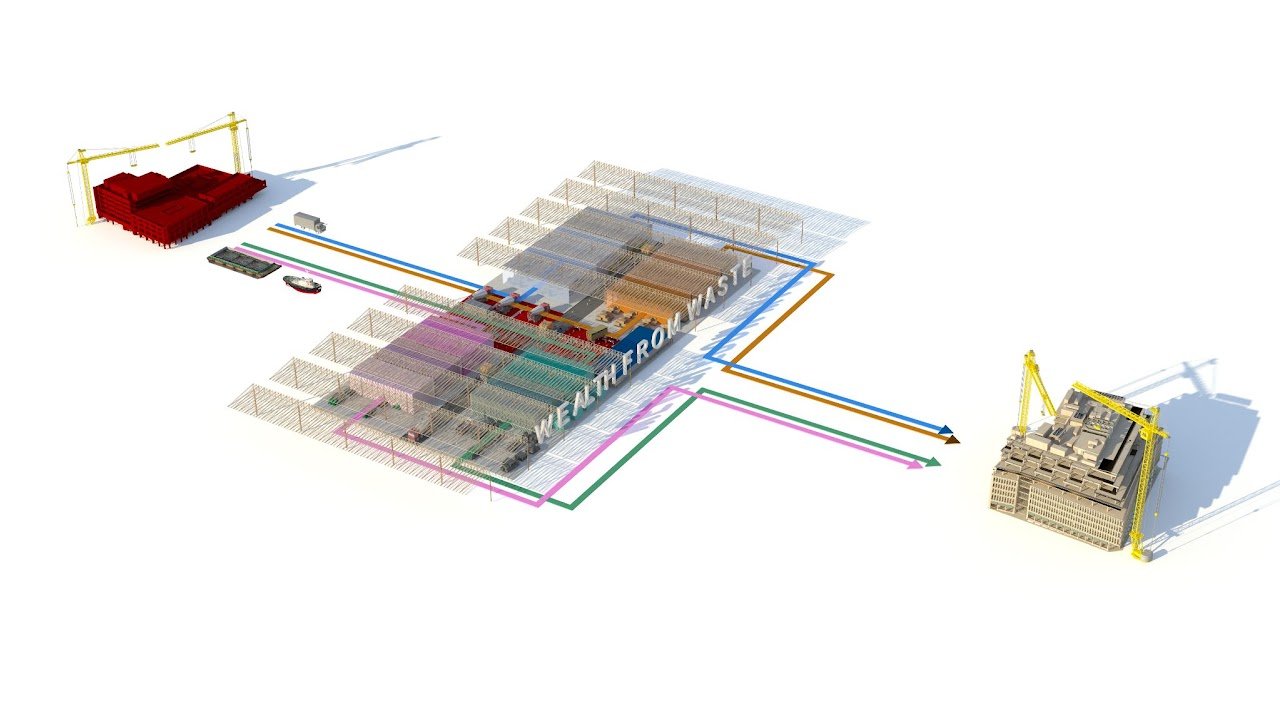
The Engineers Reuse Collective is a key project participant in NuBau Labs™, a €4m Horizon Europe-funded initiative launched this month to tackle one of the most persistent challenges in construction: how to test, certify and remanufacture salvaged concrete and steel so that they can be confidently reused in new buildings.
Conceived by Arup and Queen’s University Belfast, NuBau Labs™ brings together engineering, architecture, research and manufacturing expertise from across Europe. Its first pilot hub will be established on the River Thames in East London. At the heart of the project is the concept of treating cities as “urban material banks”, where materials from existing buildings are a resource for the next generation of buildings, not waste.
The project will develop the technical standards, testing protocols and digital tools needed to make structural material reuse viable at scale. One of the first solutions to be demonstrated is ReVault, an Arup-developed floor system that reuses reclaimed concrete to create new floors, representing a 70% reduction in embodied carbon compared to conventional floor systems.
NuBau Labs™ takes its inspiration from the New European Bauhaus initiative, combining sustainability with design quality, social inclusion and local identity, recognising that circular construction is not only a technical challenge but a design and community one too.
This work sits at the heart of what tERC was set up to do. We are pleased to be contributing our knowledge to the project, and we look forward to sharing more as it develops.
For more information about NuBau Labs™, visit https://www.nubaulabs.com/
NuBau Labs™ has received funding from the European Union’s Horizon Europe research and innovation programme under Grant Agreement No. 101309038. Views and opinions expressed are however those of the author(s) only and do not necessarily reflect those of the European Union or the granting authority. Neither the European Union nor the granting authority can be held responsible for them.